.png)
Exoflex
Transforming hand therapy
Genesys collaborated with BES Rehab to develop the electronics, embedded software and control system powering the Exoflex device.


The Technology
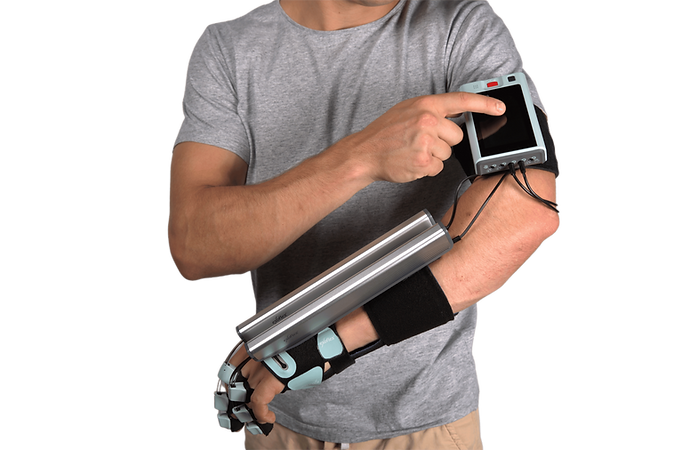
The Exoflex system delivers controlled therapeutic movement to each finger joint, enabling precise rehabilitation exercises tailored to a patient’s recovery needs. The device controls and measures key therapy parameters including speed, force and range of motion, ensuring consistent and repeatable treatment.
Health practitioners configure therapy routines using a simple web interface. These routines are then transferred to the device’s electronic control unit via Wi-Fi or a connected smartphone, allowing patients to perform guided therapy independently between clinical visits.
The system also captures therapy data during each session, enabling practitioners to monitor progress and adjust treatment programs as recovery evolves.
The Exoflex system consists of five main components:
• An exoskeleton arm worn by the patient
• An electronic control unit
• Up to five drive modules (one per finger)
• Finger nodes that connect the drive modules to the patient’s hand
• A web interface for therapy control and data collection

The Challenge
Hand rehabilitation is a critical part of recovery for many patients. It is estimated that one in three people will require some form of hand therapy during their lifetime, due to injury, stroke, or surgery.
Traditional therapy typically requires patients to attend frequent sessions with a practitioner who manually performs therapeutic manipulation. This approach can be time-consuming and inconvenient for patients, while also making it difficult to deliver consistent therapy or objectively measure recovery progress.
BES Rehab set out to develop a system capable of delivering precise, repeatable therapeutic movement to individual finger joints, while allowing therapy routines to be customised and monitored remotely by healthcare professionals.

The Exoflex system provides controlled movement therapy for each finger joint in the patient’s hand. The device controls and measures speed, force and range of motion, enabling carefully prescribed rehabilitation routines.
Practitioners configure therapy programs through a simple web interface. These routines are then transferred to the device’s electronics control unit via Wi-Fi or smartphone connectivity, allowing patients to perform therapy independently at home.
The system also captures data during each therapy session, enabling clinicians to track recovery progress and adjust treatment plans accordingly.
The Solution


Genesys Engineering Contribution
Genesys Electronics Design developed the electronics hardware, firmware and control software for the Exoflex drive unit and supported the project through regulatory compliance, validation and testing. The industrial design for the device was delivered by Design + Industry.
A major engineering challenge was delivering precise and synchronised movement across multiple finger joints. While the original concept proposed using only two motors, the final design required 14 synchronised motors to achieve the level of therapeutic control required.
Genesys developed a synchronisation routine that pre-loads therapy movement data before each routine begins, ensuring all joints move at the correct time and with the correct force.
Another challenge was accurately measuring the force applied to each finger joint during therapy. In collaboration with Spatial Freedom, Genesys developed a novel sensing approach using infrared beams and optical masks to measure changes in tension and compression within the mechanism, enabling precise force measurement during rehabilitation exercises.

Impact
Peter Abolfathi, creator of Exoflex, commented:

The Exoflex system enables patients to perform high-quality rehabilitation therapy outside of clinical settings while allowing practitioners to remotely configure therapy routines and monitor progress.
The technology has received multiple international awards, including the British Council Eureka Prize for Inspiring Science and the National Disability Awards for Excellence in Technology.
From connected medical devices to diagnostic platforms, Genesys Electronics Design helps MedTech innovators bring their ideas to life.